
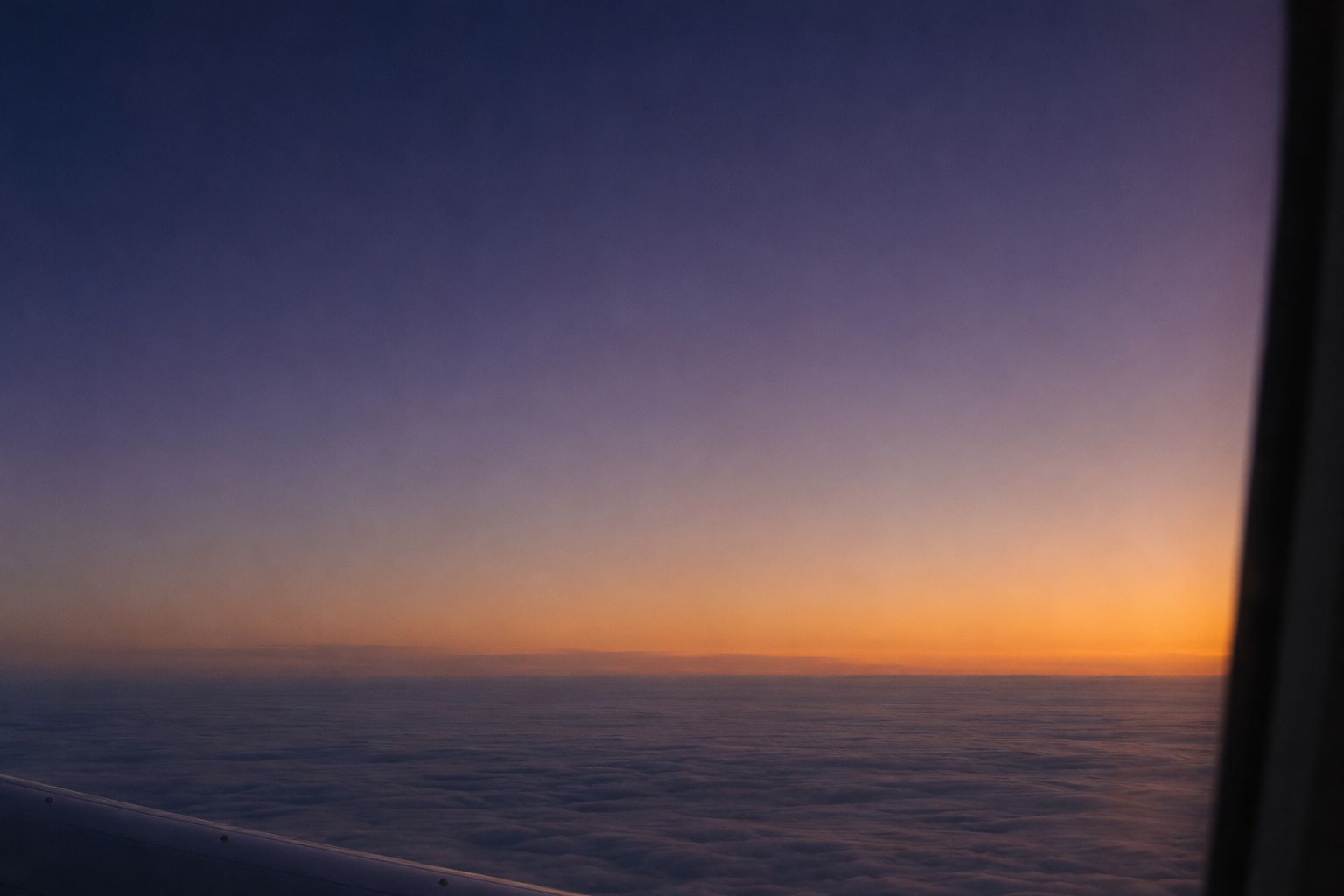
The numbers behind this chart
| Jan | Feb | Mar | Apr | May | Jun | Jul | Aug | Sep | Oct | Nov | Dec | |
|---|---|---|---|---|---|---|---|---|---|---|---|---|
| New York to Los Angeles | Near the nose | Near the nose | Near the nose | Right window | Right window | Right window | Right window | Right window | Right window | Near the nose | Near the nose | Left window |
| Los Angeles to New York | Near the tail | Near the tail | Near the tail | Near the tail | Left window | Left window | Left window | Left window | Near the tail | Near the tail | Near the tail | Near the tail |
| Chicago to Denver | Left window | Near the nose | Near the nose | Right window | Right window | Right window | Right window | Right window | Right window | Near the nose | Left window | Left window |
| Minneapolis to Dallas | Right window | Right window | Right window | Right window | Right window | Right window | Right window | Right window | Right window | Right window | Right window | Right window |
| Dallas to Minneapolis | Left window | Left window | Left window | Left window | Left window | Left window | Left window | Left window | Left window | Left window | Left window | Left window |
| Chicago to Miami | Right window | Right window | Right window | Right window | Right window | Right window | Right window | Right window | Right window | Right window | Right window | Right window |
| Miami to Chicago | Left window | Left window | Left window | Left window | Left window | Left window | Left window | Left window | Left window | Left window | Left window | Left window |
On a flight heading south, the sunset is on the right every month of the year. Heading north it’s on the left. On an east-west flight the answer changes with the date, and for parts of the year neither side is any good.
These are modelled from sun positions and straight great-circle routes, for seven routes on the 15th of each month.
North and south never change
Minneapolis to Dallas puts the sun off the right window in all 12 months. So does Chicago to Miami. Turn around and it’s the left window, all year. The sun sets in the west, you’re flying across that line, and the season only moves it forward or back along the side of the plane.
The old folk rule works here.
West flips with the seasons
New York to Los Angeles has the sunset off the right side from March to September. In June it sits about 49 degrees to the right of the nose, which is a fine view from a right window. In December and January it moves to the left, but only 13 to 19 degrees off the nose.
Around October and February it sits nearly dead ahead, 5 or 6 degrees off the nose. You won’t see much from either side, because the view is through the cockpit windows.
Two worked examples, both out of JFK:
- Leave at 8:00 PM on June 15, and the sun sets off the right side about 2 hours 15 minutes in, 46 degrees off the nose.
- Leave at 4:00 PM on December 15, and it sets off the left side about 2 hours 45 minutes in, 13 degrees off the nose.
East puts the sun behind you
Los Angeles to New York has the sunset behind the plane all year. In June it’s 45 degrees behind the left wing. In December it’s about 16 degrees off the tail, on the right. Book the side the chart names if you want the colour in the sky, but you won’t watch the sun go down.
If the sunset is the point of the trip, fly west.
West also makes it last
Flying west, you stay with the sun. On New York to Los Angeles, the longest stretch with the sun low but still up runs 160 minutes in March and 222 in December, for the best-timed departure. Going the other way it’s 31 and 39 minutes. On the ground in Chicago it’s 37 and 45.
Minneapolis to Dallas sits between them, at 66 and 86 minutes.
How this was made
For each route and month, I stepped through departure times every 15 minutes, flew each one along a great circle at 470 knots, and found the minute the sun dropped below the horizon as seen from 35,000 feet. That horizon sits about 3 degrees below level, so sunset comes later than on the ground.
A month’s result is the median across every departure that sees sunset in cruise. “Near the nose” means within 15 degrees, and “near the tail” means within 30.
Every figure on this page is modelled. Sun positions are well known, and the assumptions are the route, the speed and the altitude.
What this can’t tell you
Real flights don’t follow great circles. Winds, air traffic and airspace can bend a route by enough to change the answer when the sun sits near the nose or tail. Treat those months as a coin toss.
Clouds aren’t included, and they decide more sunsets than geometry does.
A wing or an engine can block the view. This doesn’t know your seat, your aircraft or which way the plane turns after takeoff.
It covers seven routes. Other routes run at other angles, and a route between northeast and southwest behaves partly like each case above.
The numbers behind this chart
| March | December | |
|---|---|---|
| New York to Los Angeles | 160 | 222 |
| Minneapolis to Dallas | 66 | 86 |
| On the ground, Chicago | 37 | 45 |
| Los Angeles to New York | 31 | 39 |
Report a wrong number. A corrected number keeps its old value struck through for 30 days.