
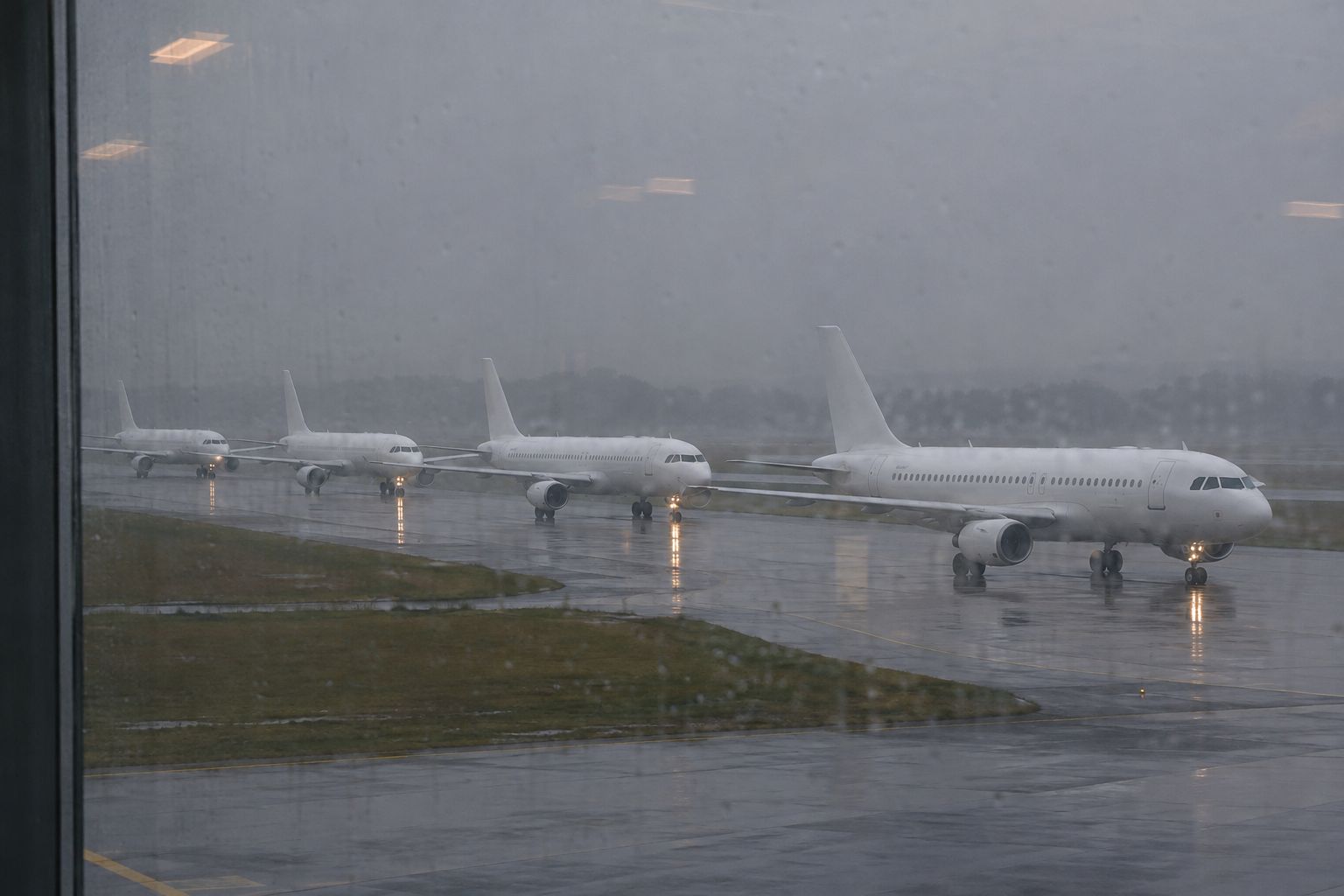
A ground stop holds flights headed to one airport at their departure points until further notice, and no flight gets a release time. A ground delay program gives each flight bound for that airport its own release time. The first is usually short and comes with little warning. The second can last all day, and it tells you how long your delay should be.
If you’re in the terminal, the difference comes down to this: in a ground stop you stay near the gate, because it can end at any moment. In a ground delay program you have a number, and you can plan around it, while still keeping an eye on it.
| Ground stop | Ground delay program | |
|---|---|---|
| What it does | Holds flights to one airport | Spaces flights to one airport |
| Your release time | None until it’s lifted | A time for your flight, the EDCT |
| How long | A short period, in the FAA’s words | A lengthy period |
| Usual cause | A short-lived problem, or a pause while a longer plan is built | Too little arrival capacity for too long, often weather |
| Who’s affected | Flights to that airport, from listed regions | Flights to that airport, from listed regions |
The FAA’s glossary gives three common reasons for a ground stop: a short spell of too much traffic, a pause to set up something longer such as a ground delay program, or an airport that can’t take arrivals at all. For a ground delay program, the most common reason it gives is low ceilings and visibility.
Both apply to the destination. A ground stop at Boston does nothing to a flight from Boston to Chicago. It holds the flight from Washington to Boston at Washington, even if the sky in Washington is clear, and that’s what confuses people at the gate.
Three advisories from one Thursday
The FAA’s command center publishes every one of these as a plain-text advisory, and Thursday, November 5, 2026 had a good spread.
Houston Hobby had a ground stop from 1:28 PM to 2:30 PM Central, for flights from the Houston and Fort Worth centers. The advisory expected an average delay of 30 minutes, a maximum of 47, a medium chance of extension, and gave the reason as “other / emergency”. It was cancelled at 1:53 PM, 25 minutes in. Anyone who wandered off for a long lunch would have cut it close.
Boston had one from 6:02 PM to 7:15 PM Eastern, because of volume. Arrivals were already holding in the air during runway construction, and the comment says the stop was “to make room for recovery” in the next hour. Maximum delay 68 minutes, average 34, medium chance of extension. A ground stop can exist to clear a line in the sky, whatever the weather at your end.
San Diego had a ground delay program from 8 AM to 8:59 PM Pacific, covering flights from every US air traffic center and 11 Canadian airports. The arrival rate was set at 24 an hour, rising to 26 for the last two hours. Maximum delay 84 minutes, average 38. The reason was volume, and the comments note arrivals and departures both on runway 27, San Diego’s only runway. Here’s part of it:
CTL ELEMENT: SAN
ARRIVALS ESTIMATED FOR: 05/1600Z - 06/0459Z
PROGRAM RATE: 24/24/24/24/24/24/24/24/24/24/24/26/26
MAXIMUM DELAY: 84
AVERAGE DELAY: 38
IMPACTING CONDITION: VOLUME / VOLUME
The times are UTC, so subtract 8 hours for Pacific in November. Each number in the rate is one hour’s arrivals.
What an EDCT means for you
EDCT stands for Expect Departure Clearance Time. It’s the time your flight should leave the runway, worked back from an arrival slot at the far end. FAA training material says controllers aim to get a flight off within 5 minutes either side.
Three things follow from that.
An EDCT is a runway time, so the door closes well before it, with taxi time added. If your EDCT is 4:10, you won’t be boarding at 4:05. The airline usually decides when to board to fit it, and the time on the board often lags.
It can also move. Airlines may swap slots among their own flights, so your flight could go earlier or later. On July 19, 2024, a ground delay program for Minneapolis was cancelled at the airline’s request, and the advisory told crews to disregard their times.
The holding happens on the ground on purpose. That’s the point of the program: the FAA’s order says it’s there to limit airborne holding. You spend the delay at a gate with a bathroom rather than circling over Lake Michigan.
What to do at the gate
If it’s a ground stop, stay close. The end of one rarely comes with notice, and a flight can board fast once it’s released. Houston’s lasted 25 minutes of a planned 62.
If it’s a ground delay program, ask the gate agent for your EDCT, or see if your airline’s app shows it. You may have time for a meal. Stay close enough to get back, since your time can move earlier.
Neither one is a reason to stay home if you’re not at the airport yet. Airlines can still board on the original schedule, and a posted delay isn’t a new departure time.
Where to see it yourself
FAA NAS Status shows current ground stops, ground delay programs and airport closures on a map. It’s public and needs no account. The advisory database has the raw text, and once you’ve read one or two it’s quicker than any news story. Flight tracking words covers the abbreviations.
These programs are one reason a flight can sit late with nothing wrong with it or its airport. A plane that arrives late because of one carries the delay onward, which is where late aircraft picks up, and Why it’s late has the rest.
An advisory is a forecast
The numbers in an advisory are forecasts by traffic managers at the time they’re written. They revise them, and the delays you see may differ. The three cases here are one day’s examples, and I haven’t counted a year of them. The public pages give the program in force, and rarely say why your particular flight got the time it did.
When air traffic control is slowing flights at your airport or at the one you’re landing at, Skycap says so on your flight with the reason it can see. It won’t tell you it’s safe to leave later, because the airline can still board on time. How delays work in the app
Sources
- FAA Air Traffic Management Glossary of Terms
- FAA, The Use of a Ground Delay Program in the US National Airspace System
- FAA Order JO 7210.3, Ground Delay Programs
- ATCSCC advisory 027, San Diego ground delay program, Nov 5 2026
- ATCSCC advisory 041, Houston Hobby ground stop, Nov 5 2026
- ATCSCC advisory 043, Houston Hobby ground stop cancelled, Nov 5 2026
- ATCSCC advisory 047, Boston arrival delays, Nov 5 2026
- ATCSCC advisory 052, Boston ground stop, Nov 5 2026
- ATCSCC advisory 119, Minneapolis ground delay program cancelled, Jul 19 2024
- FAA NAS Status