
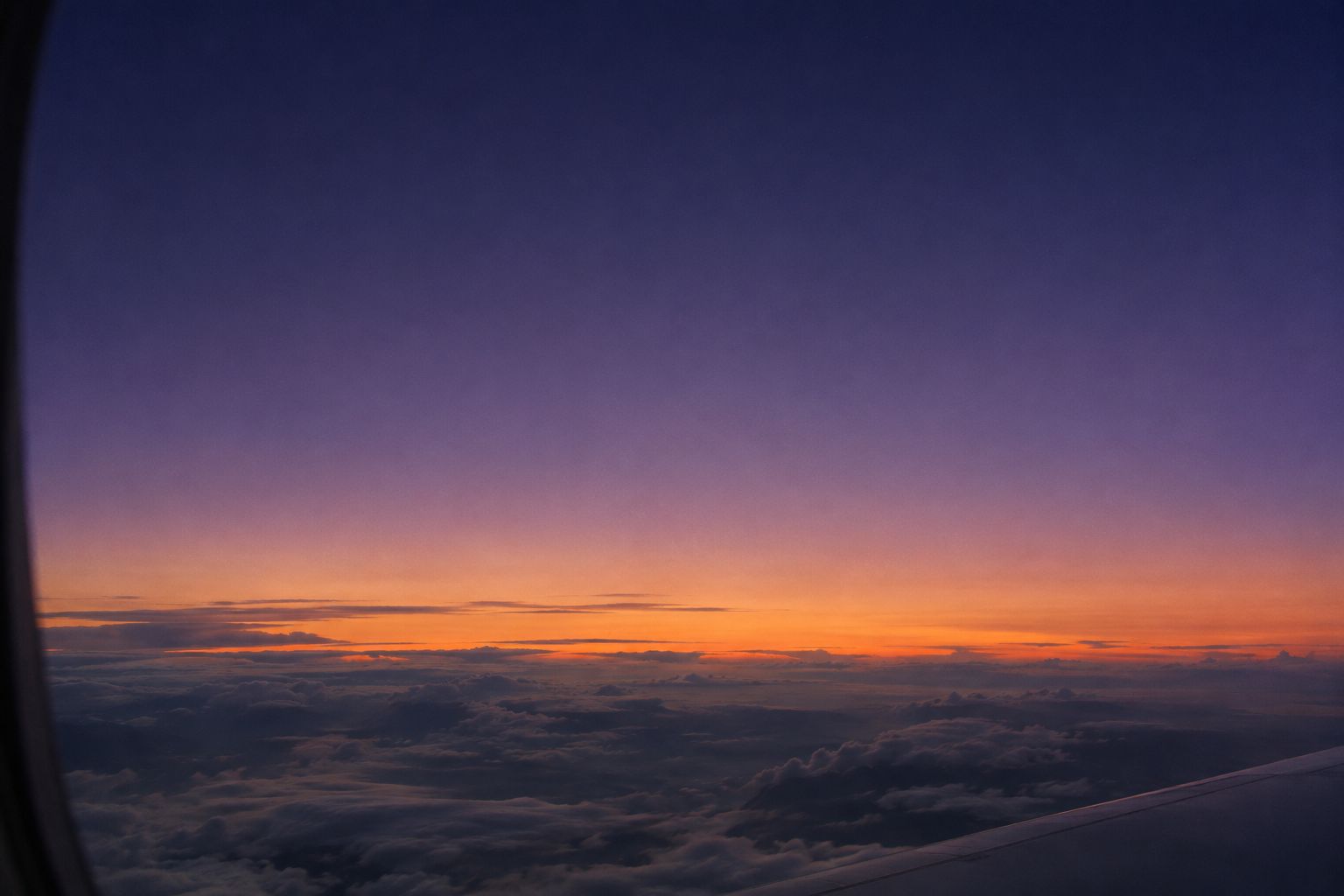
Flying north, sit on the left. Flying south, sit on the right. Those two hold all year, because the sun sets in the west. Flying east, the sunset is behind you and no window gets a good view of it. Flying west, it’s in front of you, and the season decides which side has it.
For sunrise, swap them: right when you’re heading north, left when you’re heading south, and in front of you heading east.
The westbound case is where the usual advice falls down. “Left in winter, right in summer” assumes you’re flying due west, and you mostly aren’t.
New York to Los Angeles, month by month
A flight from JFK to LAX starts out heading about 274° and ends heading about 246°, because the shortest route bends toward the southwest as it goes. By the time the sun sets, the plane has usually turned to the left of due west, and that pushes the sun to the right of the nose.
I worked out where the sun sits at the moment it sets for an evening departure:
| Date | Where the sun is at sunset |
|---|---|
| December 21 | Ahead, slightly left |
| January 15 | Ahead, slightly left |
| February 15 | Straight ahead |
| March 20 | Ahead, slightly right |
| April 15 | Right |
| May 15 | Right |
| June 21 | Right, about 45° off the nose |
| August 15 | Right |
| September 22 | Right, closing on the nose |
| October 15 | Straight ahead |
| November 7 | Straight ahead |
So on this route, book the right side from April to mid-September. From October to March the sun goes down close to dead ahead, and from a side window you get the color without the disk, so either side will do. In deep winter the left has a slim edge. The common rule gets that part right and misses the other seven months.
The same logic runs on other westbound flights. Chicago to Denver bends less, and my numbers put the sun about 40° right of the nose in mid-May and about 20° left in mid-January.
North and south are the easy ones
I ran the same sums across the year for three routes, and the side didn’t change once.
| Route | Sunset side |
|---|---|
| Seattle to Los Angeles | Right, all year |
| Boston to Orlando | Right, all year |
| San Francisco to Seattle | Left, all year |
If you only fly one direction of a route, this is the reliable kind of booking.
One worked example
Take a JFK to LAX flight leaving at 4 PM on November 7. On the ground at JFK the sun sets at about 4:46 PM. The plane keeps it for much longer. On my numbers it sets at about 7:17 PM New York time, 3 hours 17 minutes after takeoff, somewhere over southern Colorado, within a degree or two of straight ahead.
Two things stretch that sunset.
The first is height. At 35,000 feet the horizon sits about 3° below level, so at around 40° north the sun goes down 17 to 19 minutes later than it does on the ground beneath you.
The second is direction. Earth’s surface at 40° north turns east at about 795 mph, and a jet heading west at around 530 mph is running with the sunset, although it’s losing. By my calculation, on that November date the sun takes about an hour to go from 5° above the horizon to 6° below it for someone standing still at 40° north. Flying west it takes about three hours. Flying east, 37 minutes.
If you’d rather not have the sun at all
Around the middle of the day at mid-latitudes, the sun is to the south. So on a daytime flight across the US, it stays on the left going west and on the right going east. Every sample flight I ran, in November and in June, came out that way, apart from the last hour or so of an eastbound June flight, when the sun was behind. If you want to sleep or see a screen, take the opposite side: right going west, left going east.
Sunrise out of JFK to Europe works the same way as any eastbound flight: it’s ahead, a little right in January and to the left in June. If you’re staying awake for it, what you can see at night will fill the hours before.
How I worked this out
The sun’s position comes from standard solar position formulas, evaluated each minute along a great-circle route at 460 knots and 35,000 feet with no wind. Sunset is the moment the sun’s top edge drops below the horizon as seen from that height. I call anything within 20° of the nose “ahead”, because from a side window that’s a glow more than a sun.
There are more routes, month by month, on the sunset side page.
What the sums leave out
The real route won’t be the great circle, as why your flight path curves explains, and a headwind moves the time. It can’t see clouds. It also won’t know that your window seat is level with a wing, or has no window at all, so check the seat map too. If bumps matter more to you than the view, the smoothest seats are the ones over the wing.
Skycap works this out for the flight you’ve booked, from its route and departure time, and tells you which window to sit at and about when the sun goes down. See the window guide